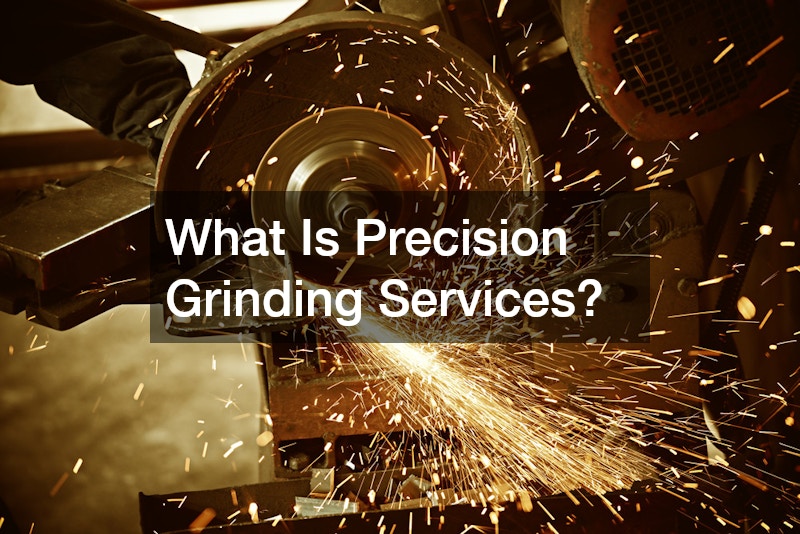
In the world of modern manufacturing, the difference between a high-performing component and a total system failure often comes down to a few microns. As machinery becomes more complex and tolerances become tighter, traditional machining methods sometimes fall short of the required accuracy. This is where precision grinding services become indispensable. These services utilize specialized abrasive wheel machinery to remove minute amounts of material from a workpiece, resulting in surfaces that are incredibly flat, cylindrical, or contoured with extreme dimensional accuracy.
Precision grinding is typically a finishing process. It is the final stage of production after a part has been cast, forged, or rough-machined.
While a lathe or a milling machine can get a part “close” to its final dimensions, precision grinding services provide the refinement necessary for aerospace, medical, and automotive applications where there is zero margin for error.
At its core, grinding is a cutting process. However, instead of a single-point cutting tool like a drill bit, a grinding wheel acts as a multi-point cutter. Each grain of abrasive on the wheel’s surface acts as a tiny tool that shears off a microscopic chip of material. Because these grains are so small and the wheel spins at such high velocities, the process can achieve finishes that are far smoother than what is possible with traditional cutting tools.
The success of the process depends on several variables:
-
The Abrasive Type: Common materials include aluminum oxide, silicon carbide, and “super-abrasives” like cubic boron nitride (CBN) or diamond.
-
The Bond: This is the material that holds the abrasive grains together. It must be strong enough to hold the grains during cutting but “friable” enough to let go of dull grains so new, sharp ones can be exposed.
-
Coolant Application: Grinding generates significant heat. High-quality precision grinding services utilize advanced coolant systems to prevent thermal damage or warping of the metal.
Surface Grinding
This is perhaps the most common form of grinding. It is used to create a flat surface on a workpiece. The part is typically held in place by a magnetic chuck while a horizontal wheel passes over the material. This is essential for creating base plates, shim stocks, and tool-and-die components that must sit perfectly flush against other surfaces.
Cylindrical Grinding
When a part is shaped like a rod or a tube, cylindrical grinding is used. The workpiece rotates on a fixed axis while the grinding wheel moves across its surface. This is vital for creating axles, camshafts, and spindles. There are two main types: “between centers” grinding, where the part is held at both ends, and “centerless” grinding.
Centerless Grinding
Centerless grinding is a high-speed, high-volume process where the workpiece is not held by a spindle or centers. Instead, it is supported by a work-rest blade and held between a high-speed grinding wheel and a regulating wheel. This method is incredibly efficient for producing large quantities of small parts like pins, bolts, and hydraulic valve spools. Many industries rely on centerless precision grinding services to maintain high throughput without sacrificing the tight tolerances required for mechanical assemblies.
Internal Grinding
As the name suggests, this process involves grinding the inside diameter of a part. It is commonly used for finishing the inner bores of bearings, bushings, and cylinders. Because the grinding wheel must be smaller than the hole it is entering, this requires high-speed spindles to maintain the necessary surface feet per minute for a clean cut.
Material Versatility
One of the greatest advantages of grinding is its ability to work with extremely hard materials. While traditional steel can be milled or turned, hardened tool steels, ceramics, and exotic alloys like Inconel are often too tough for standard carbide tools. Precision grinding can handle materials that have been heat-treated to high Rockwell hardness levels. In fact, many parts are heat-treated first to achieve their structural properties and then sent to precision grinding services to correct any distortions caused by the heat-treatment process.
In precision manufacturing, “close enough” does not exist. The standard unit of measurement in these shops is often the “tenth,” or one-ten-thousandth of an inch (0.0001″). To put that in perspective, a human hair is roughly 0.003 inches thick. A precision grinder is working with measurements thirty times smaller than a hair.
Precision grinding is the unsung hero of the industrial world. It is the bridge between a raw piece of metal and a high-performance engine component. By utilizing the right abrasive technology and expert craftsmanship, these services provide the accuracy, surface finish, and geometric integrity that modern technology demands. Whether it is a flat surface, a perfect cylinder, or a complex internal bore, the reliability of our modern infrastructure depends on the meticulous work performed by precision grinding services. As we move toward more automated and high-tech futures, the need for this level of extreme accuracy will only continue to grow.